
How to Choose the Right Vacuum Sealer Bag for Hunting & Meat Storage
How to Choose the Right Vacuum Sealer Bag for Hunting & Meat Storage
What Should You Look for in a Vacuum Sealer Bag?
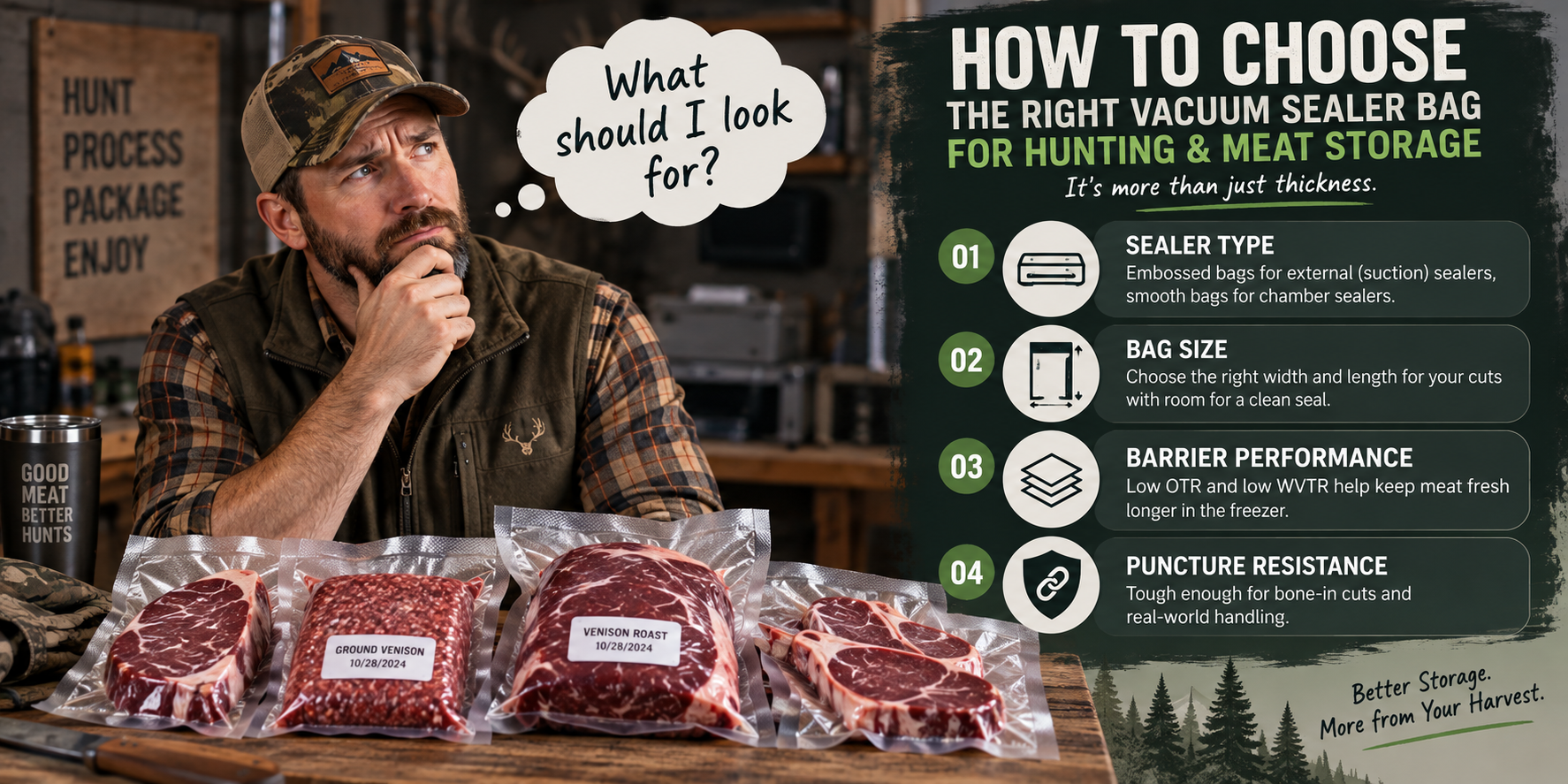
The right vacuum sealer bag depends on four things: sealer type, bag size, barrier performance, and toughness needed for the cut you’re packaging.
- Sealer match – embossed/textured bags for external (suction) sealers, smooth bags for chamber sealers
- Size – wide and long enough to fit the cut with room for a clean seal, without excess material
- Barrier performance – a low oxygen transmission rate (OTR) and low moisture vapor transmission rate (WVTR/MVTR) for longer freezer storage
- Puncture resistance – important for bone-in cuts and rough field-to-freezer handling
- Format – pre-cut bags for repeatable portions, rolls for custom lengths
Bag thickness (mil) is only one part of the picture.
According to the USDA Food Safety and Inspection Service, freezer burn happens when air reaches the surface of food; it doesn’t make food unsafe, but it does affect taste, texture, and color- exactly what GardaPack’s Prime vacuum bag is designed to prevent.
Why Choosing the Right Vacuum Bag Matters
A hunting season doesn’t end when the animal hits the ground. There’s scouting, the hunt itself, field dressing, processing, trimming, and portioning- hours of work before a single steak reaches the freezer.
Storage is easy to treat as an afterthought. It shouldn’t be. A bag that doesn’t fit the sealer, doesn’t hold a seal, or lets air and moisture in during freezer storage undercuts all that earlier effort.
The bigger issue here is quality, not safety. The USDA’s Food Safety and Inspection Service is clear that food stored continuously at 0°F remains safe indefinitely, and freezer burn itself doesn’t make meat unsafe to eat.
What’s at stake is quality, taste, texture, and how much of that hard-earned harvest you actually want to eat instead of trim away and toss.
That’s the practical cost of the wrong bag: wasted packaging, re-sealing, freezer-burned cuts.
So, what should you actually look for when choosing vacuum sealer bags for hunting and meat storage?
Recently, we discussed the complete process of hunt to storage in our “Field-to-Freezer guide”.
1. Start With Your Vacuum Sealer
Not all vacuum bags work with all vacuum sealers, and this is the first thing to sort out before you buy a case of bags.
External (suction) vacuum sealers are available on the countertop and are often the ones that people have at home or at a smaller commercial establishment. The sealer attaches to the end of the bag that is open, sucks the air out through the bag, and seals it.
The bag needs a textured surface or embossing to get air out efficiently, and small ridges form channels along which the vacuum pump sucks the air out between the layers before the seal closes.
Chamber vacuum sealers work differently. The entire bag containing the food is placed inside a sealed chamber, and the machine vacuums the entire chamber rather than sucking air through the bag.
Because air is evacuated from the entire chamber rather than drawn through the bag’s surface, using non-textured bags ensures a flatter, more secure seal that effectively prevents leaks and food spoilage.
GardaPack Prime bags use embossed, textured film designed for standard external/suction vacuum sealers.
2. Choose the Right Bag Size
Bag size is easy to overlook until you are at the counter with a bunch of bags that are too small or that are wasteful. Some considerations:
- Width and length should fit the cut with enough headspace for a clean, wrinkle-free seal
- Oversized bags waste material and freezer space; undersized bags can strain the seal or leave a cut only partially covered
- Pre-cut bags suit repeatable portions such as steaks, burger patties, standard roast sizes.
- Custom-cut rolls suit variable cuts, from ground venison one week to a larger roast the next
There’s no single “best” size for wild game. A hunter processing mostly stored ground venison and steaks may prefer 8″ pre-cut bags, while someone handling elk roasts may need the 11″ width or a roll cut to length.
3. Don’t Judge a Vacuum Bag Only by Thickness
It’s easy to assume that the thicker a vacuum bags in terms of mil thickness, the higher the number, the better. However, thickness is just one of the factors that affect a bag’s performance over the course of months in a freezer.
It is the construction of the bag itself, the number of layers, the materials that comprise them, and the barrier materials between them, that is more important.
A thicker bag isn’t automatically a better bag. Film construction, the number of layers, and the presence of a dedicated barrier layer can have a bigger impact on performance than mil thickness alone.

4. Look at Oxygen Transmission Rate
Oxygen Transmission Rate (OTR)
OTR measures how much oxygen can pass through a packaging film over a given area and period of time.
A lower OTR means less oxygen can pass through the film over time. That matters because oxygen exposure can contribute to oxidation and quality loss, affecting the meat’s color, flavor, and texture. 5. Consider Moisture Protection for Freezer Storage
But oxygen is not the only thing that can affect meat during freezer storage. WVTR (also known as MVTR) determines the amount of moisture that will pass through a film over a period of time.
WVTR measures how easily water vapor can pass through the film. Good moisture-barrier performance helps reduce moisture loss from the packaged meat, which is important for minimizing freezer burn during long-term storage
6. Wild Game Needs More Than a Tight Seal
A tight vacuum seal doesn’t mean much if the bag tears during handling. Wild game presents challenges that a lot of general food-storage bags aren’t built around: bone-in cuts, sharp edges from trimming, and the rougher handling that comes with field processing and hauling coolers.
Puncture resistance is worth checking separately from barrier performance, since a bag can have excellent OTR and WVTR numbers and still tear around a sharp edge.
7. Pick the Right Bag Format
Once sealer type, size, barrier performance, and puncture resistance are settled, format comes down to how you process meat:
- Pre-cut bags are simplest for repeatable portion sizes, no measuring- good for steaks or standard burger portions
- Standard rolls give flexibility for custom lengths when cut sizes vary
- Long rolls with a cutter dispenser suit higher-volume processing over a busy weekend
- Combo dispensers with two widths help when you’re regularly packaging both smaller cuts and larger roasts
The right format depends on how much meat you process and how consistent your cuts are.
8. So, What Makes a Good Vacuum Sealer Bag for Hunters?
A good hunting vacuum bag should fit your sealer, fit the cut with enough headspace for a clean seal, provide reliable barrier protection for long-term freezer storage, resist punctures during normal handling, and come in a format that matches how much meat you process.
Why GardaPack Prime Fits These Requirements
Sealer compatibility
Hunters using standard external/suction vacuum sealers need an embossed bag so air can be drawn out through the film during sealing.
Prime uses embossed/textured film built for that category of machine, the most common type of countertop sealer among home and small-commercial users.
Long-term freezer storage
If you’re storing a season’s harvest, Prime’s EVOH poly-nylon construction is designed around independently tested OTR and WVTR performance to help slow oxidation and moisture loss during long-term freezer storage.
Wild-game cuts
Bone-in cuts and rougher field-to-freezer handling call for a bag that can withstand the rougher handling involved in field-to-freezer processing.
Prime’s independently tested puncture resistance (EN 14477, Engineering Materials Laboratory, Inc.) is a relevant data point for venison, elk, or other game with sharp edges to work around.
Custom portions
Not every harvest breaks down into the same cut sizes. Prime’s roll formats, including the long rolls with a cutter dispenser, let you cut to the exact length a portion needs, avoiding wasted material on odd-sized cuts.
What Comes Next
Choosing the right bag is the first decision, not the last one. How you cool, trim, package, and freeze the meat afterward plays just as big a role in final quality.
GardaPack’s Deer Storage Guide walks through that full field-to-freezer process, from processing table to long-term storage.
Once you’ve matched your sealer, sized your bags correctly, and understand what OTR, WVTR, and puncture resistance actually tell you, picking a bag for this season’s harvest is a lot less guesswork, which is exactly the point of putting in the extra hours out in the field in the first place.
Q&A
Do all vacuum sealers use the same bags?
For external/suction sealers, embossed or textured bags are required to allow air to be pulled out of bags when sealing.
Unlike external suction sealers, a chamber sealer will typically use smooth bags because the air is evacuated from the entire chamber, eliminating the need for textured channels to release the air.
What vacuum bags are best for meat?
This will depend on your sealer and storage requirements. When choosing a bag for freezer storage, consider a multi-layer bag that has a true oxygen and moisture barrier, is the right size for the cut (small excess headspace is acceptable), and will be strong enough to take the weight of bone-in cuts without ripping.
What thickness should vacuum sealer bags be?
There is no single correct thickness for every application. The barrier performance is more dependent on the construction of the film (e.g., the number of layers, the presence of a dedicated oxygen barrier layer such as EVOH) than the mil thickness.
Does OTR matter for freezer storage?
Oxygen Transmission Rate (OTR) is the amount of oxygen that will pass through the bag as time passes. A lower OTR will help to maintain better flavor, color, and texture of frozen meat over an extended storage period because oxidation, which causes deterioration in the quality of the product, is promoted by exposure to oxygen.
What size vacuum bag should I use for deer meat?
Steaks, burger parts, and smaller cuts will fit in 8″ pre-cut bags; roasts and larger cuts will need an 11″ width or a roll which you can cut to a desired length. Leave enough extra material above the meat to create a clean, reliable seal, but avoid excessive headspace that wastes bag material.
