
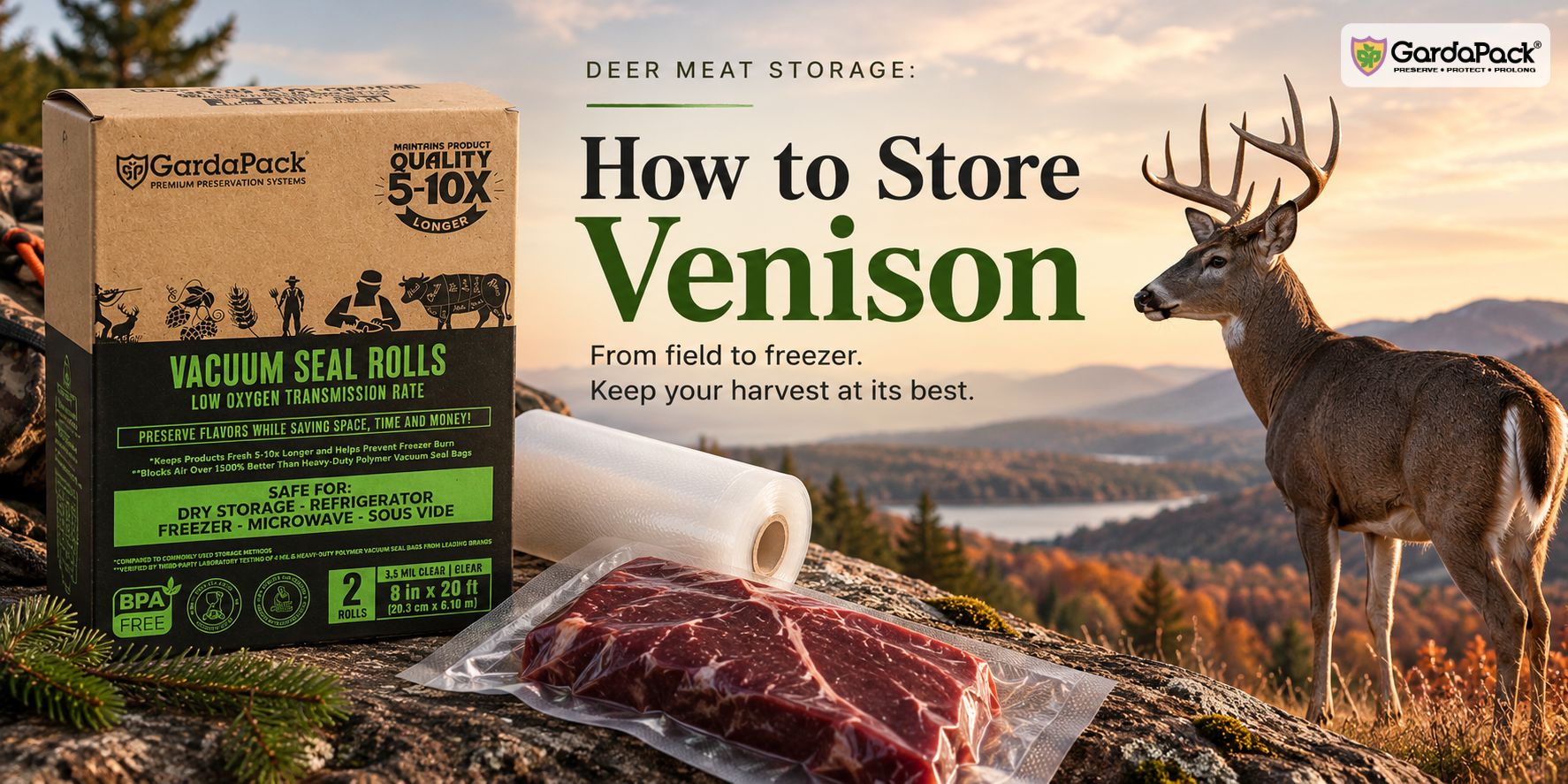
Deer Meat Storage: How to Store Venison
Deer Meat Storage: How to Store Venison
Process the meat, portion it by cut, get a tight vacuum seal, label every package, and get it into the freezer fast. That’s deer meat storage in a nutshell. Miss any of these steps, and it can cost you quality meat months later.
You put in the scouting, the cold mornings, and the work of field dressing and processing. What happens in the next few hours how you package and freeze that venison—can determine whether it still tastes great months later or comes out freezer-burned, dried out, and disappointing.
Storage isn’t an afterthought. It’s a system: process, portion, package, seal, label, freeze, and organize.
Vacuum sealing your harvest with quality game meat bags is the backbone of that system for many hunters today, and the bag itself matters as much as the sealer you’re using.

Big-game hunting is part of the American outdoor experience, and the National Deer Association’s 2026 Deer Report states that there was a total of over 3 million bucks with antlers and 3.1 million antlerless deer harvested across the United States during the 2024 hunting season. (Source)
What Is the Best Way to Store Deer Meat?
The best method of storing the meat is to process it properly, serve in correct sizes for actual cooking, label it, and freeze it promptly and flat in a vacuum-sealed package especially designed for this purpose.
- Process the meat properly — trim silverskin, fat, and hair before packaging.
- Cut and divide meat into convenient sizes (steaks, roasts, ground meat, stew meat).
- Choose the right cut of bag (thickness and puncture is more important for Bone-in pieces).
- Vacuum seal to pull out excess air.
- Inspect every seal before freezing.
- Label with cut, date, and weight if you track it.
- Freeze packages quickly and lay them flat so they freeze solid as fast as possible.
- Organize the freezer so you use older meat first.
Skip any one of these, and you’re gambling with months of freezer time.
How to Prepare Deer Meat for Freezer Storage
Good storage starts at the processing table, not the freezer. Trim away silverskin, connective tissue, and excess fat.
Portion with your kitchen in mind. You can leave a backstrap whole or cut it into individual steaks. Ground venison usually gets packaged in one-pound increments because that’s a convenient amount for many meals and recipes.
Cubed venison and stew meat should be packaged in portions you’ll be able to cook without having to thaw out additional meat.
Whichever bag you choose, be sure that the seal is not wet or dirty. Seal line moisture, grease or bone dust will eventually get in the package causing freezer burn.
Vacuum Sealing Deer Meat
Vacuum sealing is a common method for hunters who want their venison to last through the season and beyond. Pulling air out of the package does a few specific things:
- Helps reduce air exposure around the meat’s surface
- Helps protect against freezer burn
- Creates a tighter, more compact package for freezer organization
- Supports longer-term frozen storage compared to loosely wrapped meat
How to Prevent Freezer Burn on Deer Meat
Air and moisture are two of the key elements that cause freezer burn on your harvest.
Preventing it means controlling that chain at every step:
- Get a reliable vacuum on the package — don’t rush the sealing process
- Use a bag with strong oxygen and moisture barrier properties beyond thickness
- Check every seal for gaps, wrinkles, or bubbles before freezing
- Watch for punctures from bone edges or sharp trim
- Keep the freezer organized so packages aren’t getting crushed, jostled, or torn later
A single pinhole can slowly let air back into an otherwise well-sealed bag. That’s why bag construction plays such a big role in whether your venison holds up over months in the freezer.
Choosing the Right Vacuum Bag for Deer Meat
Not all vacuum bags are built the same, and wild game can be harder on vacuum-seal bags than typical kitchen foods. When picking a bag, you should think about:
- Thickness — heavier mil film generally holds up better to processing and handling
- Barrier properties — how well the film blocks oxygen and moisture over time
- Puncture resistance — critical for bone-in cuts, ribs, and irregular trim
- Bag dimensions — matching the bag to the cut avoids wasted material or overstuffed packages
- Embossed/textured construction — creates channels that let air escape efficiently with external sealers
- Roll vs. pre-cut — rolls let you size bags to the cut; pre-cut bags are faster for standard portions
This is where the bag itself becomes part of your storage system.
Why GardaPack Prime Is Built for Deer Meat Storage
GardaPack Prime bags are positioned as a premium vacuum-seal option, and their construction is built around the specific demands of wild-game processing.
EVOH Barrier
EVOH (Ethylene Vinyl Alcohol) is a specialty barrier resin layer within Prime’s poly-nylon film that helps limit oxygen transmission through the packaging.
In Prime’s construction, it’s part of what supports the bag’s low Oxygen Transmission Rate.
Low Oxygen Transmission Rate (OTR )
A lower OTR simply means less oxygen passes through the packaging material over time. Less oxygen exposure over months in the freezer means less opportunity for oxidation to affect the meat’s quality.
Independent lab testing shows Prime blocks oxygen over 1500% better than other leading heavy-duty embossed vacuum seal bags.
Low Moisture-Vapor Transmission
Moisture control matters as much as oxygen control for frozen meat. Prime’s construction is built around a low Water/Moisture Vapor Transmission Rate to help prevent moisture imbalance and protect texture, which is a meaningful factor in guarding against freezer burn over long-term storage.
Puncture Resistance
Wild game brings real puncture risk from bone edges, irregular cuts, handling during processing, and packages shifting around in a chest freezer.
Prime’s enhanced puncture resistance is built to outperform standard 4-mil and 5-mil co-extruded bags.
Freezer Paper vs. Vacuum Sealing for Deer Meat
| Factor | Freezer Paper | Vacuum Sealing |
| Air exposure | Some air remains trapped against the meat | Significantly reduced through active vacuum |
| Package size | Bulkier, less uniform shapes | Compact, stackable packages |
| Freezer organization | Harder to stack neatly | Easier to organize and inventory |
| Long-term storage | Workable for shorter freezer windows | Better suited to longer-term storage when sealed well |
| Convenience | Fast, low equipment cost | Requires a sealer and bags, but faster to sort later |
Neither method is “wrong”; plenty of experienced hunters still use freezer paper for quick, short-term storage. Vacuum sealing simply gives you more control over air exposure for meat you plan to keep frozen longer.
Common Deer Meat Storage Mistakes
- Using a bag that’s too small or too large for the cut, wasting material or leaving too much air
- Rushing the vacuum cycle and ending up with a weak seal
- Skipping the seal inspection before freezing
- Packaging bone-in cuts without accounting for puncture risk
- Forgetting to label packages, leading to freezer mystery meat
- Letting the freezer become disorganized, so older packages get buried and forgotten
- Assuming all vacuum bags perform the same regardless of thickness or barrier quality
- Focusing entirely on the sealer brand while treating the bag as an afterthought
Bringing It Together
Good deer meat storage isn’t one decision; it’s a chain of small ones, from the processing table to the freezer shelf.
If you’ve already read our complete field-to-freezer guide for storing wild game broadly, this article gives you the deer-specific playbook for turning your harvest into venison that still tastes great months later.
With effort invested in harvesting a deer, your storage should afford protection for the animal that returns home with you.
GardaPack Prime bag offers a high-barrier, puncture-resistant vacuum-seal option built with wild-game processing in mind a practical upgrade for hunters who want their venison to hold up over the long haul.
FAQ Section
What is the best way to store deer meat?
Process as soon as possible, serve portions, place in a vacuum-sealed bag, label well, and freeze as soon as possible. A well-planned freezer can help minimize the incidence of lost packages.
How should I store venison in the freezer?
Vacuum-sealed packages must be frozen flat to speed up freezing and can then be stacked after freezing. Keeping the freezer organized by date helps you use older venison first.
Does vacuum sealing prevent freezer burn on deer meat?
The chances of freezer burn from air will be greatly reduced using vacuum sealing, but not eliminated. Eventually, if the seal is not tight, air can seep back in the freezer and food may not freeze properly, so all the seals should be checked before placing food in the freezer to freeze.
What vacuum bags are best for deer meat?
Choose a bag that is thick in construction, has strong barrier properties against oxygen and water, and has actual puncture resistance. Bone-in cuts and irregular trim are tougher on packaging than typical kitchen use.
What size vacuum bag should I use for venison?
This will depend on the cut. If you’re using a standard cut such as a steak or chop, pre-cut bags are great, but if you have a large piece of ground venison, roast, or a weirdly shaped venison cut, rolls are a better choice.
