
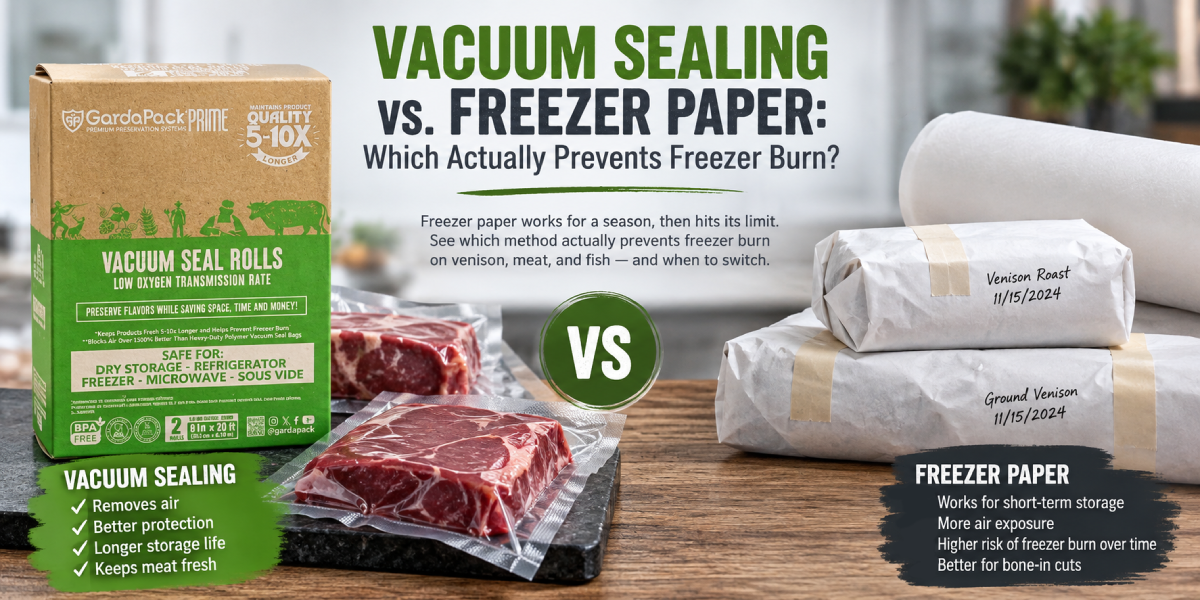
Vacuum Sealing vs. Freezer Paper: Which Actually Prevents Freezer Burn?
Vacuum Sealing vs. Freezer Paper: Which Actually Prevents Freezer Burn?
Freezer burn can ruin your harvest before you even cook it. Meat gets dry, fish loses quality, and a whole week of hunting and processing goes to waste.
Freezer paper and vacuum sealing are two of the most common and effective ways to prevent freezer burn. While freezer paper can work for short-term storage or bone-in cuts, it may not provide the same level of protection for long-term storage. Here’s why, and how to actually get it right.
First, let’s look at how each method works.
What Is Vacuum Sealing?
Vacuum sealing is done with a machine that removes the air from a vacuum seal bag. The result is a tight, close-fitting package where the plastic is stretched out and snug against the meat with very little air between.
For anyone who freezes meat, fish, or wild game for over a couple of months, vacuum sealing is a common choice.
What Is Freezer Paper?
Freezer paper is a thick paper coated with plastic that guards food against air and moisture in the freezer.
Meat is hand-wrapped from the outside and is tightly folded and taped with freezer tape. It is a simple method, like with a butcher counter, and doesn’t need a special tool, other than scissors and tape.
What Causes Freezer Burn?
Freezer burn is not spoilage. Freezer burn happens when moisture leaves the surface of frozen food and turns into ice crystals. Air exposure speeds up this moisture loss, leaving dry, tough, grayish-brown patches on the meat.
Air is the trigger. Any pocket of air trapped against the meat’s surface, from a loose wrap, a stretched bag, or a weak seal, gives moisture somewhere to go. The bigger the air pocket and the longer it’s there, the worse the damage.
Read our detailed guide on: Beyond Thickness: Why OTR and WVTR Are the Real Secrets to Vacuum Seal Freshness
Vacuum Sealing vs. Freezer Paper: How They Compare
| Factor | Vacuum Sealing | Freezer Paper |
| Air removal | Near-total | Depends entirely on wrap quality |
| Freezer-burn protection | Strong, if the seal holds | Moderate, best for shorter timelines |
| Moisture retention | High | Moderate |
| Long-term storage (9–12+ months) | Well suited | Quality drops off faster |
| Durability against punctures | Weaker, bone and sharp edges are a real risk | Stronger, tears less easily |
| Space efficiency | Excellent, flat, stackable | Bulkier, irregular shapes |
| Equipment needed | Vacuum sealer and bags | Paper and tape only |
| Best for | Backstraps, steaks, ground meat, long freezer stays | Bone-in cuts, short-term storage, no equipment on hand |
Why Vacuum Sealing Helps Prevent Freezer Burn
Vacuum sealing removes most of the air from the bag before it is sealed.
The less air, the less sublimation and consequently the less freezer burn. It also limits oxygen exposure, which can help slow oxidation and reduce off-flavors in fatty cuts over time.
That said, vacuum sealing isn’t foolproof. A bag punctured by a sharp bone edge, a seal contaminated with grease or blood, or a bag that gets nicked while you’re digging through a packed chest freezer will let air back in, and once that happens, the meat behaves the same as if it were never vacuum-sealed at all. The packaging only works as well as the seal holds.
How Freezer Paper Protects Meat
Freezer paper is plain paper with a thin plastic or wax coating on one side. Wrapped correctly, coated side against the meat, edges folded tight, taped shut. It creates a real barrier against air and moisture.
It’s been the standard at butcher counters for generations for good reason: it’s cheap, it’s tough, and it doesn’t rely on any equipment.
Its limitation is that it can’t remove air the way a vacuum bag does. Even a careful wrap leaves small air pockets against the meat’s surface, and those pockets are where freezer burn starts.
Which Is Better for Venison and Wild Game?
Backstraps and steaks
These are great candidates for vacuum sealing. They are flat, boneless and uniform in shape, sealing to prevent leaks and are good for long storage.
Ground venison
Ground venison also works well with vacuum sealing, particularly when using one pound containers. Pack it flat and freeze quickly and easily.
Bone-in cuts (shanks, ribs, some roasts)
This is where freezer paper, or a double-wrap approach, genuinely has an edge. Punctures are often caused by sharp bone edges.
Wrapping bone ends in plastic wrap or another piece of freezer paper before vacuum sealing or wrapping these pieces of meat will prevent the issue, or using freezer paper for these cuts only.
Large-volume seasons
If you’re processing a lot of meat, vacuum sealing’s space savings in a chest freezer make a real practical difference over a season or two.
Read our Field-to-Freezer Guide to Stopping Freezer Burn using vacuum sealing.
Which Method Fits Which Food? A Quick Product Comparison

| Food Type | Freezer Paper | Vacuum Sealed |
| Whole fish or dense roast | Holds up well for a couple months, thick wrap and short timeline mean small air pockets don’t have time to do damage | Also performs well; extends usable storage well beyond the paper timeline if needed |
| Ground meat, sausage, or fattier cuts | Becomes less effective, more surface area and fat exposed to oxidation over a season leads to gray, dry patches | Removes the air causing the problem, making it the more reliable choice for a full season in the freezer |
| Meat already showing freezer burn in paper | Re-wrapping in more paper won’t fix it, the same air-exposure issue persists | Re-sealing in a vacuum bag resolves it, since the air that caused the burn is gone |
Can You Use Freezer Paper and Vacuum Sealing Together?
Yes, and some processors have several layers of protection on valuable cuts: they first tightly wrap the meat in plastic wrap so that air cannot get in, and then they vacuum seal or freezer paper wrap it so that the air does not get in.
It is more work per package, but not always needed with normal cuts; a good choice with a trophy animal or if you know you’ll be storing your meat in the freezer for an extended period.
Common Vacuum-Sealing Mistakes That Still Cause Freezer Burn
Even good vacuum bags fail for predictable reasons:
- Bone punctures. Sharp edges on shanks, ribs, or chops cut straight through the plastic.
- Wet or greasy seal lines. Moisture, blood, or fat on the bag edge keeps the seal from bonding fully.
- Trapped air pockets. Bags loaded too full, or with an odd shape, can seal with pockets of air still inside.
- Rough handling in a packed freezer. Constant shuffling and digging can nick or stress seals over months.
- Skipping a second seal line. Many experienced processors run an “insurance seal” about half an inch above the first, a small extra step that catches a weak first seal before it becomes a problem.
Where GardaPack Fits In
GardaPack is a U.S.-based vacuum-sealed packaging company that focuses on vacuum-sealed packaging designed for demanding storage conditions, including the needs of hunters and wild-game processors.
For the scenarios above where freezer paper reaches its limit, fattier cuts, longer storage windows, or meat that’s already come out freezer-burned once, a puncture-resistant vacuum bag like GardaPack Prime is designed specifically to hold a seal through a full season of chest-freezer handling, bone-in cuts, and everything else a real hunting harvest puts it through.
The Verdict: Vacuum Sealing or Freezer Paper?
For most hunters, most of the time, vacuum sealing is the better choice for freezer-burn prevention, especially for backstraps, steaks, and ground venison you want to keep tasting good well past the season.
Freezer paper still earns its place for bone-in cuts, short-term storage, or as a reliable backup when you don’t have a sealer handy. The real deciding factor isn’t just which material you use, it’s whether the seal actually holds.
A puncture-resistant bag such as GardaPack Prime combined with a clean seal line and a second insurance seal on high-value cuts means you have the greatest chance of getting your meat package open next fall and having the meat still look and taste like it did the day you processed it.
FAQ
Does vacuum sealing completely prevent freezer burn?
It will significantly minimise the risk but does not remove the risk. Even if the bag is punctured or not completely sealed, air and moisture can still get in to the meat.
Is freezer-burned venison safe to eat?
Yes. Freezer burn is a quality issue, not a safety issue, according to USDA guidance. Trim the affected areas, and the rest is fine to cook and eat.
How long does freezer-paper-wrapped venison last?
Typically a few months to around nine, depending on how tightly it’s wrapped and how consistent your freezer temperature is.
Can I use freezer paper on bone-in cuts instead of vacuum sealing?
Yes, it’s often the smarter choice, since freezer paper resists punctures from bone edges better than thin vacuum bags.
What’s the single biggest mistake that causes freezer burn?
Trapped or reintroduced air, whether from a loose paper wrap, a punctured bag, or a seal that never fully closed.
