
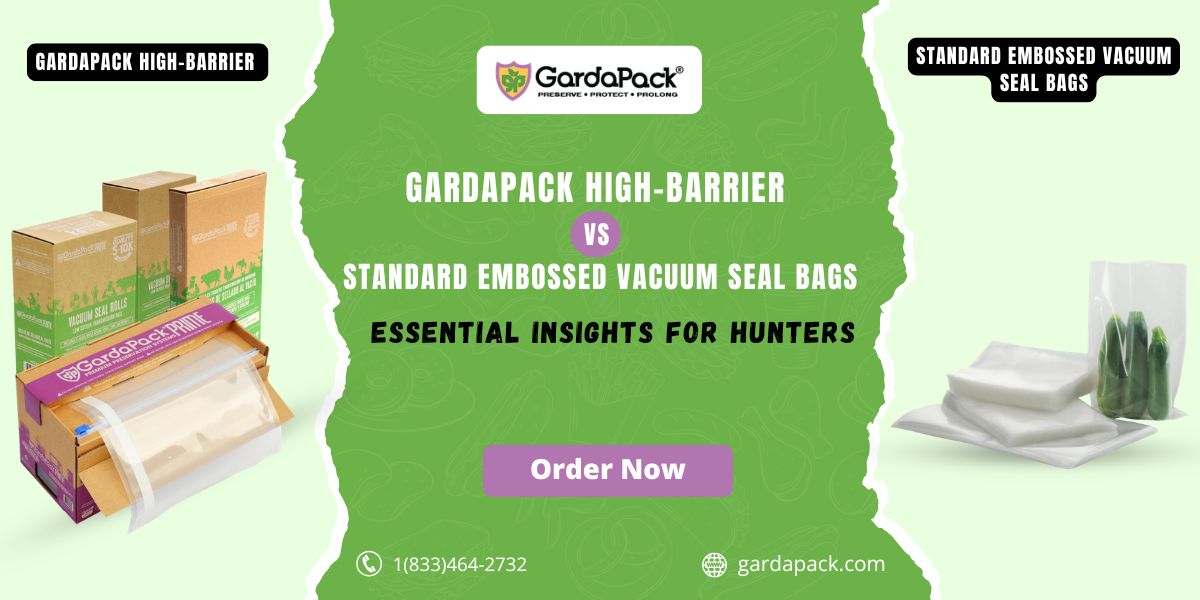
GardaPack High-Barrier vs. Standard Embossed Vacuum Seal Bags: Essential Insights for Hunters & Fishers
GardaPack High-Barrier vs. Standard Embossed Vacuum Seal Bags: Essential Insights for Hunters & Fishers
You spent weeks scouting, sat through freezing mornings, or spent hours on the water to land your catch. The arduous work of field dressing, processing, and trimming followed. Then, a few months later, you pull a package from the freezer only to find gray, dry meat covered in frost crystals. Freezer burn and oxidation have wasted your entire harvest.
This annual disappointment usually comes down to the storage method. Oxygen exposure and moisture loss are the sole culprits behind freezer burn and spoilage. While hunters and fishers widely use vacuum-seal bags to prevent this, not all bags are created equal.
Understanding the fundamental differences between standard vacuum bags and advanced high-barrier films ensures your hard-earned wild game and fish retain their peak flavor, color, and texture for years to come. Here is what you need to know before processing your next harvest.
The Core Technical Differences
In the flexible packaging industry, film barriers are categorized by specific, rigorous performance metrics rather than just thickness.
True High-Barrier Status Defined by OTR
A film is classified as “High-Barrier” based strictly on its Oxygen Transmission Rate (OTR), which dictates how effectively a film resists the transmission of gas through its walls. To meet the formal industry standard for high-barrier status, the collective average of both the embossed (textured) and flat sides of a vacuum seal bag’s film must not average greater than 10 cm³/m²/24 hrs when laboratory tested at 23°c and 0% Relative Humidity (RH).
Moisture Protection Parameters (WVTR)
Conversely, industry standards treat the Water Vapor Transmission Rate (WVTR / MVTR) as an item-dependent variable rather than part of the overarching baseline definition, as moisture protection requirements vary entirely depending on the specific item being packaged.
Due to the extreme sensitivity of wild game proteins and the delicate fats of fish to sublimation in a freezer, an elite average WVTR of under 2.5 g/m²/24 hrs (tested at 38°C and 90% RH) is highly recommended for embossed vacuum bags to truly halt dehydration.
Standard Vacuum Bags:
Standard embossed bags typically feature a basic, co-extruded construction of a 3–4 mil Polyamide (PA/Nylon) exterior and a standard Polyethylene (PE) interior. The Polyamide layer achieves only moderate oxygen protection, resulting in an OTR of approximately 60 cm³/m²/24 hrs—falling well short of the industry’s high-barrier threshold and allowing oxygen to continuously migrate through the bag wall over time.
Furthermore, their ability to prevent moisture loss relies entirely on a thin layer of standard PE, resulting in an inadequate WVTR of approximately 4.5 g/m²/24 hrs. This completely fails to meet the recommended 2.5 g/m²/24 hrs protective benchmark for game and fish. While standard bags are affordable and perfectly suitable for short-term storage (under 90 days), their baseline multi-layer strength poses a structural risk with bone-in cuts or heavy handling.
GardaPack High-Barrier Bags:
Instead of relying on standard configurations, GardaPack High-Barrier bags combine a thick, superior-quality moisture-control PE with true, industry-defined high-barrier protection. These 5.5 mil films utilize advanced engineered polymers, sandwiching an elite core layer of EVOH (Ethylene Vinyl Alcohol) between protective outer layers.
EVOH forms an almost impenetrable molecular shield against gas transmission. It easily surpasses the industry limit by delivering a stellar average OTR of just 1.78 cm³/m²/24 hrs while keeping moisture locked in with an average WVTR of 2.00 g/m²/24 hrs. This advanced engineering also provides up to 2× greater puncture resistance, making it an absolute necessity for long-term meat and fish preservation.
Performance Comparison: Standard 3–4 Mil Co-Extruded vs. GardaPack High-Barrier
The data below highlights how material composition alters a film’s protective capabilities, demonstrating that thickness alone does not determine a proper barrier.
| Performance Metric | Standard 3–4 Mil Co-Extruded Film | GardaPack High-Barrier 5.5 Mil Film | Target / Industry Significance |
|---|---|---|---|
| Primary Material | Polyamide (PA / Nylon) + Standard Polyethylene (PE) | Advanced EVOH Co-Polymer + Engineered Multi-Layer Polymers | Dictates molecular defense and gas-blocking capabilities. |
| Oxygen Transmission Rate (OTR) (Lower is better) | 60.00 cm³/m²/24 hrs | 1.78 cm³/m²/24 hrs | Max 10 cm³/m²/24 hrs Limit: Required to achieve industry “High-Barrier” status (tested at 23°C, 0% RH). |
| Water Vapor Transmission Rate (WVTR) (Lower is better) | 4.5 g/m²/24 hrs | 2.00 g/m²/24 hrs | Under 2.5 g/m²/24 hrs Target: Recommended benchmark to prevent sublimation and freezer burn (tested at 38°C, 90% RH). |
| Puncture Resistance | Baseline Multi-layer Strength | 2X Greater Puncture Resistance | Critical for preventing slow leaks caused by sharp bones or ice crystals. |
| Film Thickness | 3–4 Mil (Standard) | 5.5 Mil | Impacts physical durability and handling ruggedness. |
| Frozen Shelf Life | 3–6 Months | 12–36 Months | Maximum window for safe, premium-quality storage. |
| Best Used For | Fast turnover, short-term use (under 90 days) | Long-term preservation (6–36 months), premium cuts, & bone-in meats. | Aligns packaging costs with consumption timelines. |
The Science of Freezer Burn
Freezer burn is the physical consequence of two distinct chemical and thermodynamic processes occurring simultaneously inside an inadequate storage bag:
1. Sublimation
Even at sub-zero temperatures, water molecules inside meat tissue attempt to migrate toward the surface and evaporate. This thermodynamic phase change—where ice turns directly into water vapor without becoming liquid—is called sublimation. Sublimation begins the moment food enters the freezer if the material’s WVTR is inadequate. When moisture escapes from the meat, it forms white, frosty ice crystals on the surface, leaving the protein dry, tough, and virtually flavorless. Standard films (≈ 4.5 g/m²/24 hrs WVTR) allow this process to occur rapidly, whereas GardaPack (2.00 g/m²/24 hrs WVTR) effectively prevents it.
2. Oxidation
- Lean Wild Game: Lean protein game meats (such as venison, elk, or waterfowl) lack the protective fat marbling of domestic beef and are incredibly susceptible to rapid rancidity and structural breakdown from oxidation.
- Fatty Fish: Conversely, the highly delicate fats found in fatty fish (such as salmon, trout, tuna, or mackerel) are extraordinarily sensitive to oxygen exposure.
When oxygen migrates through standard thin-walled films, it reacts with these delicate proteins and fats, resulting in chemical oxidation, swift rancidity, severe off-flavors, and a dull, unappealing grayish-brown color. GardaPack High-Barrier’s advanced OTR performance locks oxygen out entirely, stopping this destructive chemical breakdown in its tracks.
Recommended Film Thickness & Selection by Cut
To optimize your processing budget, allocate your bag inventory based on the value, duration, and structural shape of your harvest.
| Venison & Fish Cut | Recommended Configuration | Packaging Considerations & Shelf Life |
|---|---|---|
| Ground Venison, Fish Trim, & Bait | 3–4 Mil Standard | Acceptable for short-term storage (under 90 days). Uniform shapes seal easily; high volume makes bag cost a factor. |
| Steaks, Chops, & Fish Fillets | 4–5 Mil Standard / High-Barrier | Upgrade to GardaPack High-Barrier if keeping past 3–6 months to preserve delicate color, lean proteins, and sensitive fats. |
| Backstraps, Loins, & Premium Roasts | 5.5 Mil GardaPack High-Barrier | Premium cuts warrant maximum environmental defense. Extends frozen shelf life out to 12–36 months. |
| Bone-In Cuts (Ribs, Shanks, Whole Fish) | 5.5 Mil GardaPack High-Barrier | Sharp bone ends, fins, and ice crystals demand elite puncture resistance to prevent microscopic pinholes and seal failures. |
Pro Tip for Peak Quality
It is always a best practice to pre-freeze fresh meats and fish on a tray before running them through a vacuum sealer. Pre-freezing locks the blood, juices, and natural moisture firmly inside the muscle tissue. This prevents valuable liquids from being pulled up into the vacuum channel during the sealing cycle, ensuring a flawless, airtight thermal weld and a far more tender, flavorful meal when cooked.
Final Summary: When Is High-Barrier Worth It?
Because high-barrier packaging utilizes specialized polymer chemistry and an EVOH layer, it carries a slightly higher per-bag cost than standard co-extruded alternatives. However, the investment serves as incredibly cheap insurance for hundreds of pounds of organic wild game and fish.
- Choose GardaPack High-Barrier bags if your storage timeline exceeds 3–6 months, if you are preserving premium cuts, if you are packaging bone-in meats or whole fish, or if your harvest lives in an auto-defrost freezer that experiences temperature fluctuations.
- Choose Standard vacuum bags if the meat is guaranteed to be consumed within 60 to 90 days, or if you are processing massive bulk batches of ground venison for fast turnover.
Don’t let inadequate packaging undo all the hard work you put in the field or on the water. Protect your harvest with the low OTR and low WVTR protection it deserves.
